By SCM Professionals
Healthcare organizations invest significant time and effort developing strategies designed to improve performance, enhance patient care, strengthen financial sustainability, and drive operational excellence. In executive meetings and strategic planning sessions, these initiatives often appear clear, logical, and well aligned.
Yet many organizations discover that even the most thoughtfully designed strategies struggle to achieve their intended outcomes.
The reason is often found in a critical but frequently overlooked area of the organization: the operational middle.
The Bridge Between Vision and Execution
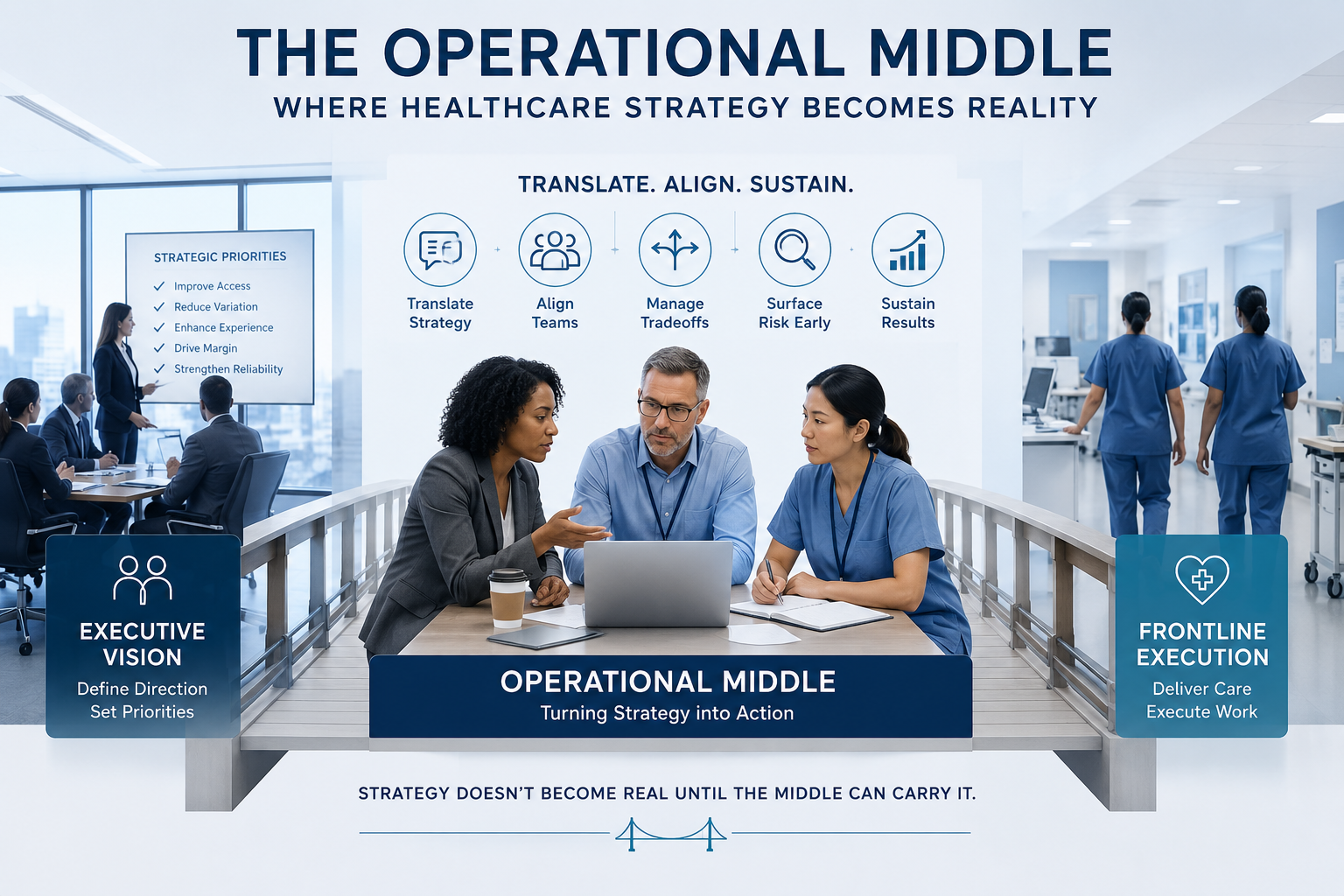
The operational middle sits between executive leadership and frontline teams. It includes directors, managers, supervisors, service line leaders, project owners, analysts, and other key influencers responsible for translating strategy into action.
While executive teams define direction and frontline staff deliver care and services, middle leaders are tasked with answering the practical questions that determine whether transformation succeeds:
- Who owns the work?
- Which processes need to change?
- What priorities take precedence?
- How will success be measured?
- How do financial goals align with clinical needs?
- How do we engage teams already managing significant workloads?
These questions rarely fit neatly into a strategic presentation, yet they represent the reality of organizational change.
Why the Operational Middle Matters
Healthcare organizations often focus heavily on strategy at the executive level and execution at the frontline level. Both are essential.
However, without strong leadership in the middle, the connection between vision and execution begins to weaken.
When middle leaders are equipped and engaged, they help:
- Translate organizational priorities into practical action
- Align teams around shared objectives
- Manage competing priorities and tradeoffs
- Surface operational risks early
- Sustain momentum during periods of change
Without this layer of leadership, even well-designed strategies can become fragmented as individuals interpret goals through different perspectives and experiences.
A directive to “standardize” may be perceived as eliminating flexibility. A focus on cost reduction may be interpreted as reducing service quality. A push for accountability may feel like increased reporting rather than improved performance.
The result is not resistance; it is often misalignment.
The Cost of Poor Translation
One of the most common challenges in healthcare transformation is assuming that organizational agreement automatically creates organizational alignment.
Consider a seemingly straightforward initiative designed to improve how support requests are submitted, prioritized, and tracked. Executive leaders may agree on the need for greater visibility and consistency. Yet as the initiative moves through the organization, perceptions begin to shift.
Some teams may view the new process as bureaucracy. Others may see it as a barrier to obtaining support. Informal workarounds continue, and frontline staff may be asked to adopt new tools without understanding the purpose behind them.
The process technically exists, but behaviors remain unchanged.
In these situations, the issue is rarely the strategy itself. More often, the challenge lies in the organization’s ability to translate the strategy into meaningful operational change.
What Effective Operational Leaders Do Differently
Strong leaders in the operational middle do far more than communicate updates.
They create context.
They help teams understand not only what is changing, but why the change matters. They clarify expectations, define ownership, explain tradeoffs, and connect daily work to broader organizational goals.
Equally important, they serve as an early warning system for execution challenges.
When workflows are misaligned, timelines are unrealistic, or priorities conflict, effective middle leaders raise concerns early. This is not resistance to change; it is stewardship of the strategy itself.
The most successful organizations recognize that honest operational feedback strengthens transformation efforts rather than slowing them down.
The Risks of Overlooking the Middle
Organizations that underinvest in the operational middle often experience familiar challenges:
- Strategic initiatives launched without sufficient capacity
- Metrics without clear accountability
- Dashboards that measure activity rather than outcomes
- Decisions that fail to influence behavior
- Frontline teams disconnected from the purpose behind change efforts
- Leadership teams receiving overly optimistic progress updates
Over time, these challenges can create the perception that employees are resistant to change.
In reality, the organization may simply be under-supported, overextended, and operationally unclear.
Building a Stronger Operational Middle
Healthcare leaders who want strategy to deliver measurable results should begin treating the operational middle as a strategic asset.
Key actions include:
- Involving middle leaders earlier in planning and design
- Sharing the business rationale behind initiatives, not just implementation tasks
- Clearly defining decision rights and ownership
- Creating safe channels for operational feedback and risk escalation
- Equipping leaders with tools and language to communicate the “why” behind change
Most importantly, organizations must recognize that alignment is not achieved through executive approval alone.
Alignment is built throughout the organization, one layer at a time.
The Path Forward
Healthcare does not need more strategies that remain confined to presentations and planning documents.
It needs leaders who can bridge vision and execution. Leaders who can translate complexity into clarity, align teams around shared goals, and sustain progress through the realities of daily operations.
Because strategy does not become real when it is approved.
It becomes real when the operational middle is empowered to carry it forward.
Organizations that invest in this critical layer will be better positioned to navigate change, improve performance, and achieve lasting transformation in an increasingly complex healthcare environment.