By Keith Bresciani, for SCM Professionals
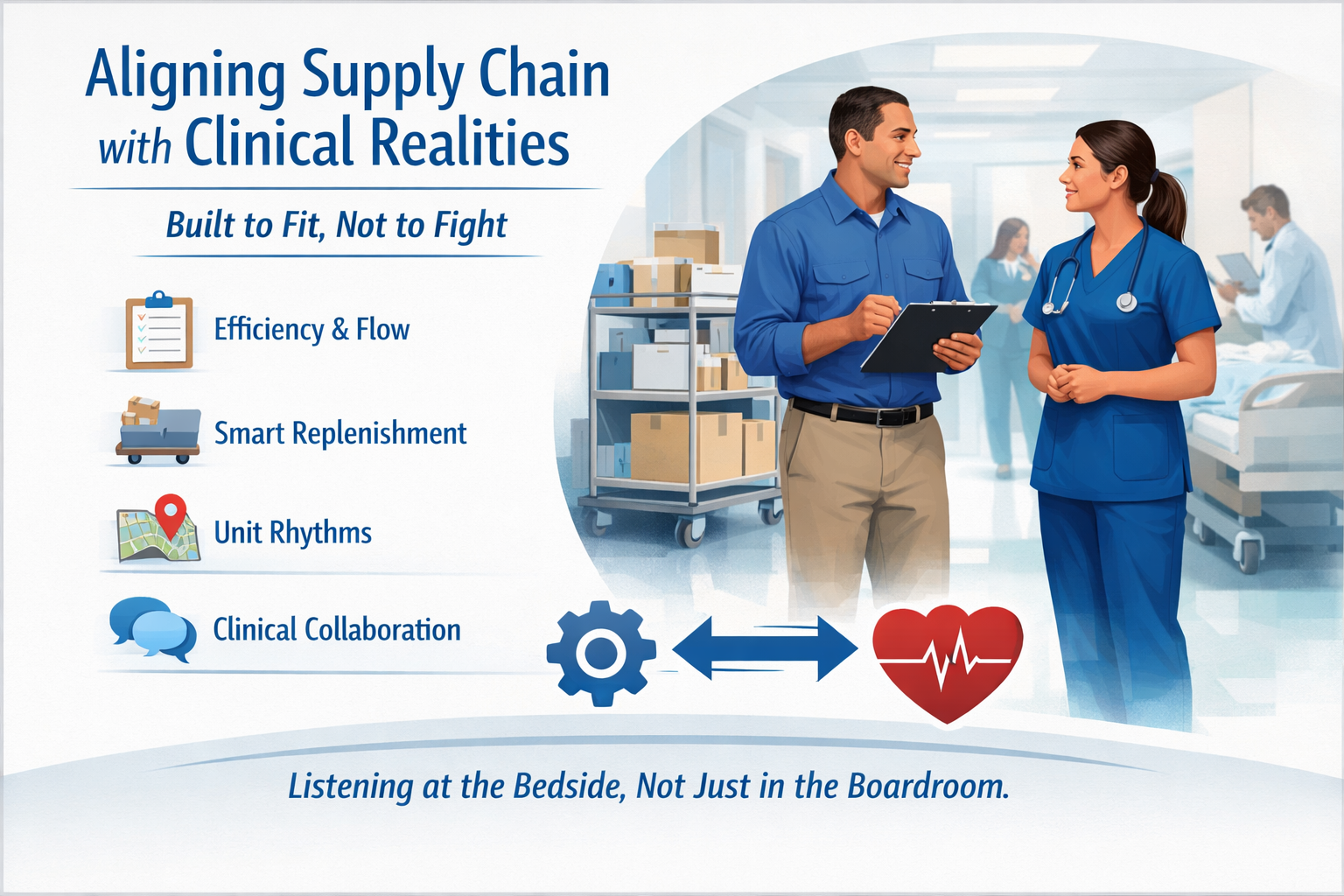
One of the quickest ways to lose trust with a clinical team is to “improve” a supply chain process without understanding what it does to their day. A workflow can look airtight on a spreadsheet, leaner par levels, cleaner routes, faster replenishment, and still fail the moment it hits the unit.
Why? Because in healthcare, the real test isn’t efficiency on paper. It’s whether the change fits the rhythm of patient care.
When supply chain redesigns are built in a vacuum, optimized for throughput instead of usefulness, they don’t usually collapse all at once. They fade. Slowly. Quietly. One workaround at a time.
Where the Disconnect Starts
Supply chain teams are trained to reduce variation, improve flow, and increase reliability. We naturally look for opportunities like:
- Fewer stockouts
- Faster replenishment
- Leaner par levels
- Smarter routing
All good goals, until they collide with clinical realities.
That friction shows up in familiar ways:
- Par carts parked in front of medication rooms
- Deliveries landing mid-handoff
- Product substitutions that confuse frontline teams
- Replenishment schedules that don’t match actual usage patterns
And the message from the unit is consistent:
- “They’re not listening.”
- “They don’t understand our world.”
- “They’re making our jobs harder.”
That isn’t a supply issue. It’s a design issue.
A Story from the Field: When the Model Meets the Unit
In one health system, our team was tasked with redesigning distribution routes across multiple campuses. The objective was clear: consolidate routes, reduce redundant trips, and increase efficiency.
The logistics model looked great. Then rollout happened, and nursing complaints spiked immediately:
- “Supplies are late.”
- “Carts are blocking patient rooms.”
- “We don’t know when anything’s coming.”
Instead of forcing the process forward, we paused and returned to the floors. That’s where the real data lived.
We learned:
- An 8:30 AM delivery collided with med passes
- Certain carts were too wide for hallway traffic during peak flow
- Some units relied on verbal cues for stockouts, and the new system removed that touchpoint
So, we refined the redesign, without abandoning the intent:
- Created unit-specific delivery windows
- Shifted cart drop locations
- Added quick-check huddles between unit and supply leads
Once clinical teams saw we were listening, friction dropped fast.
Why This Matters: Operational Harmony Is the Real KPI
In healthcare, time and attention are scarce resources. Every misaligned step costs clinical teams something: focus, time with patients, and mental bandwidth.
When supply chain workflows are invisible and seamless, that’s a win.
When they become a disruption, trust erodes, and trust is hard to rebuild.
So, success can’t be defined only by fill rate and delivery speed. The real measure is operational harmony.
What Alignment Looks Like in Practice
When workflows are designed to fit the unit, you’ll typically see:
- Deliveries occurring outside shift change and handoff windows
- Carts staged for access, not obstruction
- Replenishment tied to real usage rhythms, not just reorder points
- Communication loops that include clinical feedback
- Clinical staff feeling informed, not surprised
This isn’t about “giving in” to every preference. It’s about designing with awareness of the environment you’re serving.
How to Build Fit-First Workflows
If you’re planning a supply chain redesign, start here:
- Walk the workflow
Spend time on the floor. Watch how nurses move through a shift. Identify where supply processes help, and where they create friction.
- Map unit rhythms
Every unit has a tempo: rounding, med passes, shift changes, procedures. Build around those patterns instead of cutting through them.
- Design with, not for
Bring clinical voices into the creation phase, not just the “validation” phase. It changes the result, and the buy-in.
- Pilot with purpose
Test in one or two units. Learn quickly. Adapt. Then scale. Fast feedback beats perfect modeling.
- Create a shared scorecard
Don’t stop at logistics metrics. Track pain points, escalations, and clinical satisfaction. Make alignment a KPI, not an afterthought.
Final Thought
Supply chain excellence isn’t just about what we move, it’s about how well what we move fits into the lives of the people using it.
If a workflow looks great in a conference room but creates tension at the bedside, it’s not finished yet.
Because the best systems don’t just work on paper. They work where it matters most, on the floor, in the field, in the real-time chaos of patient care.